Showing posts with label philip glass. Show all posts

Wednesday, February 11, 2009

Philip Glass- Music in Twelve Parts (again), part 11.

I really wonder if I'll ever get over the sheer radicalism of early Glass. This is one of the prettier parts of the 12, despite its true minimalist austerity and constant pulse. The composer once described his music as functioning like wheels in a machine, which makes perfect sense to me. These arpeggios become conceptual spinning disks that morph with the music like clay on a potters wheel.

So to approach this music do we have to be armed with metaphors to describe it? Or can we just listen and enjoy? I think, since the music is so extreme in its forms and unconventional, that the only way to become accustomed to it is to approach it with this mindset. This adds to the music's radicalism, since it has to be understood through a conceptual framework, rather then through standard, accepted formulations, even for a 20th century avant-gardist. I would happily argue that the early work of Glass is some of the most challenging of the century, yet it has opened up avenues of thinking-in-music that never existed before. Suddenly music ceases to follow any western narrative form, no begining, no middle, no end. Music becomes the experience of sounds and rigorous patterns where a chord could be held for 20 minutes. Sustained tones become important-in-themselves, sustained patterns are the music. Change is not a given, it becomes a surprise.

Wednesday, July 30, 2008

I am guilty of not always viewing some of the blogs I hold in highest esteem and link on the sidebar there. But i recently stumbled upon some excellent posts in On An Overgrown path (which is named after one of my favorite works for piano)

This post reflects several of my thoughts at the moment, so i figure I best divert attention that way.

My one beef is with the term itself.- "world music" seems like an insult if we somehow exclude western classical traditions from the group. If we're talking about "traditional world musics" It better as hell include it ALL, balinese gamelan to native american pow-wow musics, to shostakovich and back. (i dont think many people would approve, though) Otherwise, we're using an essentially categorizing music in a very ethnocentric way- ie. "classical music" and "everything else thats traditional on the planet", knowing full well that separate is inherently unequal in this kind of dialogue**, I would propose that we specify which traditions we're talking about. If its Northern Hindustani Classical or Tuvan Throat singing, or Taureg traditional music. "world music" just doesn't cut it.

**I'm not going to sit around and discuss music in terms of one kind being more or less important than some other kind, and thereby creating value judgments about the nature of different music traditions. Nor am I automatically calling all music equal. The "importance" in the western sense can not be applied to other cultures where music functions and is perceived differently, and the musical values do not necessarily translate. It is simply stupid to try weigh the importance of someone like Veena Sahasraddhe against Pavarotti, just as one does not judge a Kandinsky as they would a Botticelli.

Sunday, December 16, 2007

End of Quarter Laziness

im just sitting around, being rather un-productive. eating, surfing Youtube,etc. Anyway, the other day I found a video of my favorite work of Philip Glass, Music in a Similar Motion ( its broken into two videos, actually, since it goes over youtube's video time limit.)

And its lovely. During my roadtrip across California and Oregon this summer it was music that kept me calm in stressful moments of (generally California) driving. My passenger was not always pleased, but he was able to deal with it, and i think it might have even rubbed off on him.


So here are some pics from said roadtrip..
.

Friday, October 05, 2007

My Favorite Glass

Ok, yeah, more Youtube, but this is some GOLD. Here are brief clips from the early 70z of the ensemble practicing the gorgeous music in changing parts , and later we hear a brief bite of music in a Similar motion (my favorite work), as well as rare footage of Einstein being performed.


I fucking love this stuff, i eat it up. The best part is that every different performance i hear makes it sound so new and fresh, its so new and daring still. God i love it.

Monday, August 27, 2007

i have to get minor toe sugery today. Stupid big toe and its problems.

Currently listening to Glass. I figured out how to open two winamps at once and thought it'd be fun to make a recording of me playing music in 12 parts at the same time. Like tape looping, except with winamp, and no loops are involved, just me sliding the music around as i feel fit. Its fun.... More on that craziness later.

Sunday, June 10, 2007

Nachoqatsi

From Youtube:


na - cho -qatsi (from the Hopi language), n. 1. Nacho life. 2. Life eating
nachos. 3. Life eating crispy tortilla chips smothered in cheese. 4. A way of
life that celebrates the consumption of nachos


Anyway, i just figured i should post this awesomeness.

Also, the official trailer for the violent videogame Grand Theft Auto 4 uses music, cut and mixed, from koyaanisquatsi with similar styled NY computer graphics. I doubt Philip would be pleased by that one, however.

Thursday, February 08, 2007

Oh sweetnesss that is all sweetness. Some of you may yawn or have already seen this but the motherload for a glassfan has been found at youtube, some videos of a much younger, longhaired vaguely stallonesque looking radical playing what is my favorite excerpt from Einstein, (train) in a recording i'd never heard. Theres also a second part where they perform the spaceship section of einstein.

Each recording of glass' early work sounds vastly different from the next, and this is no exception, allowing the listener familiar with other recordings (me) to enjoy subtlies never before made so audible, and i do have to say, im a fan of this particular performance. There are also a few words from the maestro himself in middle of the two recordings.

This discovery certainly isnt mine, so i owe it to Soho the Dog, who posted Glass' performance from the year of my birth (1986) of Rubric on an unnamed american late night tv program, which is also a quality recording. This is the point where i mourn the fact that contemporary music could have continued to play a role in american television, but seems not to. A comment on Soho's blog mentions ornette coleman being on this program at one point.... hm.

Saturday, January 20, 2007

Frank Zappa- I promise not to come in your

So internet has arrives in the dorms. Unfortunately its crappy internet (ah, la belle france), so when i went about trying to post these few words ( below), i accidentally only ended up getting the first part of the title. (frank) and then i couldn’t go back and edit the post because the internet is rather... uh, special (though, to be honest, i kinda like a post that just says "frank", very reductive, you know, reminds me of a video i saw on you tube with john cage... but im rambling (and using too many (parentheses))). So ive been unsuccessful with blogger since, im back in my ordinary location,across the parking lot outside in the cold mooching wifi in a closed uni building next door

The first 10 seconds or so are a zappa cover of the first part of Philip Glass’ Music in 12 parts (transposed to some different key).Gorgeous guitar work runs throughout the piece, but those beginning 10 seconds are still my favorite. what can i say, im a minimalist fan before a zappa fan.

So far the only other zappa piece I’ve really latched on to his El condor Pasa. im not sure where el condor it comes from, but its certainly beautiful, and doesn’t follow the same kampy in-your face-satire that most of the zappa im familiar with does.

Sunday, January 07, 2007

Philip Glass -String Quartet #5

This is the first work of contemporary music I remember being interested in. I was 13 or 14 and in my English teachers room before class. Knowing that I was a pianist he showed me some of the tracks from the kronos quartet’s recording. I even remember the track, it was the 4th movement of the 5th, and in listening I paused, “wow, that’s gorgeous, and…. interesting… and…. contemporary (?)” how could contemporary music be all three of these things? I couldn’t understand, but I was fascinated.

I went about hunting down some more Philip glass recordings, even listening to my English teachers cd in full. To be honest I was disappointed. I didn’t get all the repetitions I didn’t understand why he insisted on repeating the same phrase 4 times in a row, and so I sort of dropped my hunt for classical music recordings, and read about it instead. I remember being frustrated for years because I really wanted to get my hands on some Steve Reich, but I wasn’t able… within my means. (20 dollar CDs were out of the question, especially for something I might hate)

Im still feeling far too limited, I have practically the complete works of reich and enough (read: a ton) of glass and a lot of adams, dutilleux, I know some stockhausen, a little boulez and xenakis, and I enjoy late Coltrane quite a bit, I love me the George Crumb, my only riley is In C and the only La Monte Young piece is his well tuned piano, Im enjoying the aggressiveness of John Zorn and Animal Collective, along with the surrealism of The Dirty Projectors, Godspeed you Black Emperor and Broken Social Scene Meridith Monk has some wonderful pieces, I am familiar with a little Nyman and I love Berio’s symphonia, Messiaen is usually cool, John Cage’s prepared piano warms my heart, I also enjoy his tape works but Varese bores me, and is there anything at all interesting in Feldman’s string quartets? The Kronos Quartet is always reliable source of interesting music, Aphex Twin, Bjork and even (this is clownsilly’s fault) The boards of Canada have my interest, A Silver mount Zion, Red hot chili peppers and Nirvana often keep me company as do Sonic Youth and Radiohead. I may be in love with Michael Gordon and Julia Wolf. I love Arvo Part’s atmospherics and the Books subtle humor. I only know Ligeti’s etudes, and they honestly disappointed me. Theres a ton more out there though, that I haven’t gotten to.

Any suggestions?

...please?

Monday, July 10, 2006

Philip Glass/David Bowie/Aphex Twin - Heroes symphony re-mix (1997)

PWS made a post recently mentioning an "ideal" music. He was writing about debussy, and if you know me, i live off the stuff. Basically anything he wrote after 1888 sends me into a quivering mess on the floor in fetal-position bliss. His late music leaves me speechless in its gorgeousness, but all this talk of an ideal, well, debussy's late music is certainly one, but another ideal of mine is this piece, aphex twin's collaboration with glass and bowie. Third times a charm- or an absolutely fucking masterpiece, its a work that leaves me just as speechless and blissful as debussy. This is my modern ideal, this is the kind of music i wish to write someday- or at least, music that achieves this effect or result for me.

This is postmodernism in its most hypnotic, frantic, lush and contemporary. Imagine some film like a further-technofied koyyanisqatsi, fragmented and expressionistic, accompanying this music- I can think of nothing that would be a better art to express the hypnotic, mechanical and frenzied pace of urban life (the orginal qatsi music pales in comparison). This is a dark beauty, full of menace and propulsion, full of energy and agony, hope and despair- all those emotions expected in some19th century romantic symphony, but rapped up in a five minute intense minimalistic/maximalistic piece. There are those echoes and emotions welling up into waves, cresting into points of great tension, almost seems as if musique concrete had a singing love child with philip glass.

While other works of aphex twin have impressed me, none have left me so happy, so enthralled with the sounds of a kind of music i'd never heard before.

Monday, May 29, 2006

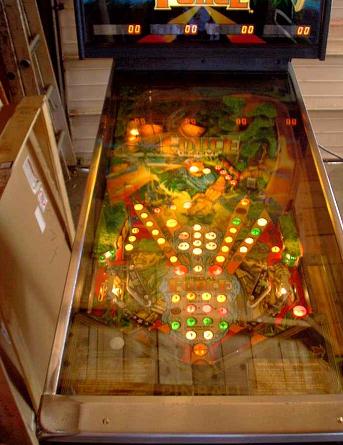
Koyaanisqatsi Pinball

fr
Wouldn’t that kick ass?

I can just see it- that severe KOYAANISQATSI lettering on the top of the back board. Push in some quarters and you’d hear that ominous basso-profundo voice uttering the title accompanied by clips of the score. There could be all those sections, the cloudscape, the grid, pruit igoe, all of that, each one could light up and play a clip when hit. The grid in particular would give the pinball-maker the chance to do some fancy lighting tricks with the board (think of the time-lapse footage of those intersections) and with cloudscape drawings of clouds could light up. There could even be an airplane section for vessels or a collapsing building with igoe (in lighting of course).

Remember in the film there are those shots of kids playing games in an old fashioned arcade, it could a chance to be a sort of self-referential thing, it’s an absolutely perfect subject for pinball, dark and mysterious, and so much of it deals with this exact kind of fast-paced insanity.

I guess this is my idée fixe for the month.

Wednesday, May 24, 2006

I have corrupted

...the soft and moldable minds of fellow dorm-dwellers

with my strange musics.

_

While stravinsky didnt fly so well, Philip Glass certainly has. I wasnt really expecting that (but if you're used to techno, i suppose it makes sense)

Its hell week now. I have an absurd amount to be doing, i have not been as good a student as i should be, and i dont have time for much to update (nor much to say).

on a cheerful note, Today, while i was playing some strange contemporary music down stairs, a woman glared at me while walking past, her hands over her ears in a threatening gesture. What can i say? i was both concerned and amused. I mean, i really really wasnt playing loud (i swear) i was being careful not to get past (f), and usually staying in mf or mp. She either had-
A) something wrong with her
B) something wrong with her ears
C) hated the music.

probably all three, i think. (am i being egotistical?)

But now i've really got to run.

Sunday, May 14, 2006

So i have just rented Koyaanisqatsi from my university library and have decided to post a few words. I have heard the music many times but have never seen the film. There is a real sense of drama in the music even without the video, but i am expecting that with it will be even more potent. The music is epic in a way, and, as far as im concerned, it is the ultimate in post-modernernity- that searing severe repetition, strict tonality and hypnotic persistence, a reflection of the contemporary urban world.

I have also read a great deal about the film, so hopefully my expectations will be met.

Tuesday, March 14, 2006

Philip Glass - Einstein on the Beach - Night Train

My favorite section of Einstein, and i cant help but think, as i listen to this music and various other more purely minimalist music of Glass (particularly 12 parts) of the things im writing about in my classes. These things all bleed together, and its quite interesting.

Im currently employed writing a dull paper about one section of Thomas Kuhn's Structure of Scientific Revolutions, and all these things in it, the stories it contains and detailed descriptions of the changes that went along with scientific discoveries that overturned previous assumptions, how that relates in so many ways to artistic breakthroughs - The controversies, the inevitable conservatism and backlash that comes with breaking with the established system, the pattern just repeats and repeats, on and on. Sometimes the reactions are more violent and angry than others - Copernicus, Galileo, and some times they just end up with mere debates within science itself. Another pattern that repeats over and over again (from Copernicus all the way up) is that the discoveries of younger generations are nearly never accepted by the older generation, its amazing really how prevalent this pattern is.


Needless to say, Dalton's conclusions were widely attacked when first announced,
and Berthllot, in particular, was never convinced...


And the other thing which relates is directly to minimalism itself. Glass' works here reflect on Kuhn's notion of a paradigm shift. (he invented the phrase, now common, in this text) but i cant think of a better kind of musical equivalent. 12 parts in particular, there is an establish paradigm for the music, this one symmetrical concept that we hear and feel and through the repetitions learn very (sometimes too) well, it goes on and feels so absolute, unchanging and then suddenly that musical paradigm shift, a split second of confusion, of revolution where what we thought was so regular and symmetrical suddenly feels so irregular, and it feels as if the earth has just moved under us. Just as Kuhn says, the old paradigm is replaced by a new one, repeating, then once more we get to know this new paradigm and its symmetries soon become clear to us... and then another shift and another paradigm comes to replace the old, sometimes these shifts are more dramatic, sometimes less, but they are always perceptible. Its a kind of cycle that pushes the music forward, despite the stagnant harmonies and repetitive rhythms.

This is the history of art too, as made clear by this juicy bit about some minimalist-hating berkeley professor. The Death of civilization? they said that about stravinsky too. How flattering!

_ _ _ _


Its a great book dont get me wrong, its just not fun to write about.

Thursday, August 25, 2005

Leopold Mozart to his son:

"I recommend you to think when at work not only of the musical but also of the unmusical public. You know that for every ten true connoisseurs there are a hundred ignoramuses! Do not neglect the so-called popular,which tickles long ears. "

Wise words. It was true in the concert halls in the 1780s and its still true today. Consequently Wolfy wrote music that would appeal to the popular tastes of his time yet still appeal to the musical public. It goes without saying that this is a very difficult task, and one that is in greater need today than ever before.

I worry that "classical" musicians and composers forget their own obscurity. If one keeps themselves occupied only with fellow musicians and cognoscenti one can easily forget, ignore, and hide away from the general public's apathy. Even John Adams and Phillip Glass, celebrities in the contemporary classical music world, are unknown by the general public, and even by many classical students.

Leopold Mozart's statements are just as relevent as they were then, yet they are 220 + years old. ...Sigh... Some things dont change.