Thursday, January 26, 2006

A few words

I am someone who is extrodinarily sensitive to this topic, so just thinking about this could may break me down to tears. Today, we cant forget, is Holocaust memorial day.

I cant really speak about it. Its emotionally draining to even expose myself to these thoughts and images. I feel stifled by what can only be expressed as an all- consuming sadness that truly causes me to cry. I feel there is nothing i can ever say or ever do that could mean something, that could mean anything in the face of such a void. I can only mourn, with painful authencity but without productivity.

You can find more information about this memorial day here.

I was correct, i couldnt even make it to the end of this post without falling apart.
I am one of those strange people who are utterly convinced that the some of the greatest (if not the greatest) piano music of the 20th century is represented by the middle and late works of Debussy...

The Etudes (1915), which im listening to today, are incredible in everyway. I have known these pieces for years and years but they're still fresh to my ears. They are timeless works- the first etude in particular, with its dark humor, warmth and brilliance, feels contemporary, as if born from post-minimalism. There is such richness and gorgeous music here,sharp irregularities and striking contrasts.

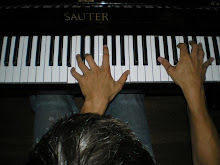
These works are quite deceptive; the technical difficulty can be substantial, though, like ballet, it always seems so simple and refined. There are all kinds of unusual things the pianist has to perform, patterns and tricks of all sorts that the pianist has get used to- there are all types of challenges, including a piece composed in a manner that essentially forces you to do Debussy's bidding - to play with only 8 fingers. This is radical stuff, Debussy produces un-heard of sounds out of the piano which are still quite new to the ears today- you don’t hear many pianos produce these sounds! There is lyricism, concentrated and fragmented musical ideas and intense emotions scattered about. In short, these etudes kick ass.

Did this man ever go wrong? really.... did he?

Tuesday, January 24, 2006

Conceptualizing Webern.

Anablog has a post of Webern's Five Canons on Latin Texts, a set of some sparkling miniatures for soprano and a small ensemble. And while i was sitting there, impatiently waiting for one of the songs to load in another browser window i clicked to get the next song loading in yet another window to try to get things moving so i could listen to them in a row without waiting fruitlessly. Well, as i expected, they overlapped a little bit. By this point i was already done listening to the first song several times (which is probably about 30 seconds of music) so i heard the first song mixing with the second, and to my surprise what resulted was not a cacophony that one might expect, or a really irregular mish-mash of lines, but a surprisingly beautiful combination that seemed to heighten the Webern-ian feel. Two sopranos instead of one, engaging in different musical dialogues simultaneously, yet fitting together.

Beautiful.

This works with Webern, any tonal composer im sure it wont. But this sudden overlap gave me the idea... i could open all 5 songs and play them simultaneously. I suggest you go to ANAblog and try this for yourself, what you'll get is some unusual, beautiful and somewhat intense combination that sounds like some sort of polyphonic Webern choir piece.

To keep the music going i loop the songs, i keep track of those five independent windows and watched the pieces get towards their end, and when this happened, i would start them again from the beginning. Because of small differences in the lengths of these pieces, there is not a strict pattern to the repetitions. I did this process for several minutes. If you listen closely you can hear each piece repeat, you can hear the musical material recycle, but because of the irregularities, there are different textures each time. this is similar to Reich's Phase technique, i suppose, but its applied to ready-made music. Its like Webern on Steroids. Its pretty fun.

Then, as a dramatic finish, i simply let all the pieces run their natural courses and gradually the voices diminish until only one is left and they end in Webern' s typically elegant and expressive manner, giving the piece(s) a punch.

So this could be someone's ready-made composition... a conceptual piece, i suppose. It could actually be any number of pieces, or in several movements, and it can constantly change. But i suggest you familiarize yourself with the pieces before you do this so you can recognize the lines before you play them all together. Its quite cool, the effect... and you can make the music go as long as you want.

Sunday, January 22, 2006


I forget how utterly strange my music is to most other people. "what the fuck" people said to me recently while playing a bit of Einstein on the Beach. "1 2 3 4 5 6 1 2 3 4 5 6 1 2 3...." and even Different Trains (which i thought was so tame) gets looks. Not only that, but i feel i've become (or became, a while ago) jaded to the avant garde. Feels like nothing phases me these days and thats no fun. The last thing i heard which i can say truly "stretched my ears" in terms of un-heard sound combinations was Vincent Bergeron's pieces, and that wasnt even a radical departure from what im used to. But i shouldnt be so dramatic. ...moooore.. i want...

However, I have to thank again the wonderous Cacophonous.org for supplying me with many wonderful things to furnish my ears, and to Analog for letting me in on some Webern i didnt know (as well as other interesting pieces). Currently, there is a gorgeous and interesting flute piece on Cacophonous- Cold Blue Noodle by Jason Taylor, and i feel an obligation to give it a few kind words it deserves. Feels like an updated version of Debussy's Syrinx. Im not sure how those overtones are produced and it seems like it would be difficult, but wonderful all the same.

All right, enough of this procrastination!

Tuesday, January 17, 2006

an age of complaisance

A professor of mine makes his thoughts and opinions clear to us. He made a point to express his view on student compliance and how my generation appears to me much more well-behaved than he likes or is comfortable with. We sit in our chairs and dont interrupt or ever contradict what he has to say. We barely participate at all.

This only re-enforces my mother's belief that we are in (a hopefully brief) period of complaisance. Knowing the behavior of people my age, i cannot pinpoint anyone any more rebellious than myself... and i aint anyone who stirs up anything radical, now am i?

Maybe the problem is that people feel there isnt much to fight for these days. Sure there's gay rights, but it seems many people are either just too homophobic or backwards to fight for the rights of gay people (though most polls show a much greater tolerance towards gays in my generation... take that religious right!). But my intense anger towards anti-gay rights and gay-intolerance will have to be saved for another non-musical post.

Ahem, music, ahem.

Musically, im afraid of an oncoming backwardness, a cynicism towards what a musician can say in a thoroughly contemporary manner, a musical complaisance towards history, if you will. Maybe us classical musicians have learned to respect our predecessors so much that to musically go beyond where they would may feel insulting to those composers we love, who wants to contradict Mozarts edicts or Brahms' pronouncements? But i ask- whats wrong with drums and strong beats? thats all it takes these days to be contemporary, after all. You can keep your consonant harmonies and melodies, you just need to contempify a little. Its painfully easy to be (post)modern.

It occurs to me that in the same way social critics connect minimalists to the rise of post-modernism in the 70s and to the repetitiveness of modern advertisement and media, i could criticize Travener, who i just wrote about, for representing some kind of back-to-the-dark-ages religious/social mentality which we can sense in the evangelicalism of Pat Robertson and more explicitly in the likes of Jerry Falwell (who openly wants public schools to close and an American theocracy), which i could then connect to the rise of fundamentalism in the late 20th century. Likewise, my mother has been concerned that many Americans have simply been choosing to be ignorant (about iraq is what she is specifically referencing), this all mixes together in the mind of the academic to represent some sort of coherent(!) movement towards ignorance, artistic "traditionalism", complaisance and fundamentalist religion.

Oh it works well.

But i just need to make it a little more convincing. Does a period of complaisance sound like a good title to you? too grand? If i wrote this paper, that might be what i call it. But the better question remains... was that in anyway coherant?


Happy Birthday Benjamin Franklin!

300 years old today! horray! Franklin was one of those few men who have been almost universally admired in life and death. He was a great enlightenment thinker, a great humanist, a great diplomat, and it was Franklin who helped create a positive p0liticial relationship with france, consequently helping to win the revolutionary war. Horray for Benjamin Franklin!

Monday, January 16, 2006

Pärtsploitaton.

I bought a CD of John Tavener's music recently. It was only 5 bucks, so it wasn’t a waste. Unfortunately, I am hostile to this music- it feels derivative rather than individual. Now, this may in part a result of the sounds the choir produces, the harmonies are different, but not dramatically.

Its beautiful music, no doubt, but it feels the same, it sounds very similar. Am i wrong in seeing his music as imitation? am i wrong in being hostile to the music because of the blatant similarities? Its a tough question. But i think what annoys me the most is the gimmicky feel of it, that it somehow seems un-authentic or that it even undermines the artistic validity of pärt's works by nature of its imitation. At the same time i am contradicted by my strong sense of what artistic freedom is, and an ironic individualism - that Travener should feel free to compose in any way he feels, if that means imitating pärt or doing something else entirely- and that the artists of many other generations utilized the languages similar to others in order to extend the possibilities of expression. It can be argued that Travener is taking an ancient language and making it new- producing something timeless. I find this to be a hallmark-card argument, but still, there is more here than can be dismissed easily.

This music also sounds similar to the music in Halo, which, oddly enough, has beautiful music that works very well with its "hyper-tech" theme.